
5 min read
Common Mistakes to Avoid When Applying for Scholarships: 18 Errors That Cost Students Funding
By Subraxo Editorial Team. Last updated 23 September 2026.
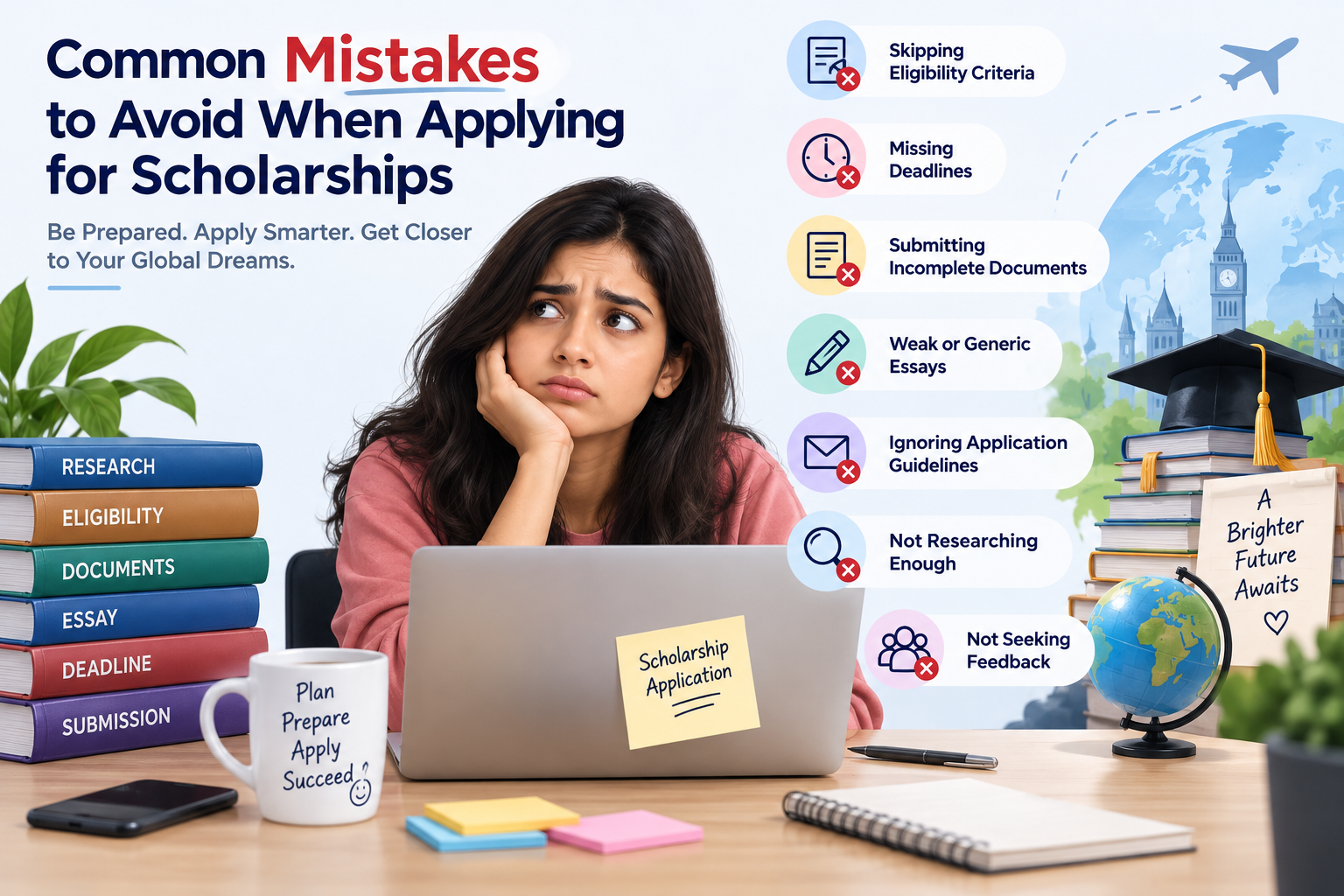
The most common mistakes to avoid when applying for scholarships are:
1. Starting the scholarship search too late
2. Applying only for big, fully funded scholarships
3. Falling for scholarship scams
4. Skimming the eligibility criteria
5. Missing admission-linked scholarship deadlines
6. Mismatched names and details across documents
7. Uploading documents in the wrong format
8. Reusing one generic essay everywhere
9. Writing a life story instead of answering the prompt
10. Letting AI write your essay
11. Ignoring word limits and instructions
12. Skipping proofreading
13. Choosing the wrong recommenders
14. Submitting on the final day
15. Going silent after you submit
16. Walking into the interview unprepared
17. Not reading the award conditions
18. Giving up after the first rejection
Most scholarship applications are not rejected because the student was weak. They fail on avoidable errors in timing, fit, paperwork and writing, so this guide walks through each mistake in the order you would meet it, from the first search to the day the money arrives, with a practical fix for every one.
Scholarship Application Mistakes at a Glance
Before going stage by stage, here is what each mistake actually costs and how long it takes to prevent. Notice that the most expensive mistakes are also the cheapest to avoid.
Mistake | Stage | What it costs you | Time needed to prevent it |
Starting late | Search | Entire scholarship cycles | A calendar and one weekend |
Only chasing big awards | Search | Realistic wins | 2 to 3 hours of extra research |
Scholarship scams | Search | Money and personal data | 10 minutes of verification |
Skimming eligibility | Eligibility | Instant disqualification | 15 minutes per scholarship |
Missing admission-linked deadlines | Eligibility | Automatic consideration | Reading the university funding page |
Document mismatches | Documents | Rejection or payment failure | One cross-check session |
Generic essay | Essay | Low score | 3 to 5 hours per essay |
AI-written essay | Essay | Disqualification | Writing it yourself |
Weak recommenders | References | A forgettable letter | A one-page brief for your referee |
Last-day submission | Submission | Portal crashes and rushed errors | Submitting 3 to 5 days early |
Ignoring follow-up emails | After submission | Treated as withdrawal | Checking inbox and spam daily |
Not reading award conditions | Post-award | Losing the award later | 30 minutes with the terms |
Why Scholarship Applications Get Rejected, Even From Strong Students
It helps to know how scholarship committees usually work. Most selection processes run in layers:
• Compliance screen: Someone, or software, checks eligibility, completeness, format and deadlines. Applications that fail here are never read for merit.
• Merit scoring: Essays, grades, achievements and references are scored against the funder's criteria.
• Interview or final panel: Shortlisted candidates are tested on fit, clarity and consistency.
The uncomfortable truth is that a large share of scholarship application mistakes happen at the first layer, where brilliance does not matter at all. A student with a 9.2 CGPA and a missing signature loses to a student with an 8.1 and a complete file. So your first job is simply surviving the screen.
Mistakes to Avoid When Searching for Scholarships
Mistake 1: Starting the Scholarship Search Too Late
Many students begin looking for scholarships after they receive their admission offer. For study abroad applicants, that is often months too late. Several major government scholarships close almost a year before the course begins, and many university scholarships are awarded in the same round as early admissions.
How to avoid it
• Start your scholarship search at the same time as your university shortlist, ideally 12 months before your intake.
• Build a single tracker, a spreadsheet works, with the scholarship name, deadline, documents required, essay prompts and status.
• Set your personal deadline 5 to 7 days before the official one.
Here is a typical scholarship timeline for a September intake:
Months before intake | What you should be doing |
12 to 10 months | Shortlist universities and scholarships, take language tests, request transcripts |
10 to 8 months | Write essays for government and prestigious external scholarships, brief your referees |
8 to 6 months | Apply for admission early enough to qualify for university merit scholarships |
6 to 3 months | Apply for private, foundation and department awards, prepare for interviews |
3 to 0 months | Accept awards, meet conditions, adjust your loan and visa funding documents |
Mistake 2: Applying Only for Big, Fully Funded Scholarships
Chevening, Fulbright-Nehru, DAAD and Commonwealth scholarships are excellent, but they attract enormous applicant pools. If your whole strategy depends on one fully funded award, a single rejection can leave you with nothing. Scholarship advisers consistently find that students have better odds with local, regional and multi-criteria awards, because every extra criterion narrows the competition.
Think of your applications as a portfolio, not a lottery ticket.
Scholarship type | Competition level | What it usually rewards | Common mistake |
Fully funded government scholarships | Very high | Leadership, career impact, return-home plans | Treating it as the only option |
University merit scholarships | Medium | Academic profile, early application | Applying for admission too late |
Department or course-specific awards | Low to medium | Subject fit, research interest | Never finding them because they sit on department pages |
Private and foundation scholarships | Medium | Mission fit, need, community background | Sending a generic essay |
Indian government schemes (NSP, state portals) | Varies by scheme | Category, income, academic performance | Data mismatches and expired certificates |
How to avoid it
Aim for a mix: one or two ambitious awards, four or five university and department awards, and a few smaller private ones. Partial awards stack up, and every rupee of scholarship is a rupee you do not have to borrow.
Mistake 3: Falling for Scholarship Scams
Scammers target anxious students and parents because urgency lowers their guard. The classic lines are easy to recognise once you know them: a scholarship "guaranteed or your money back", information "you can't get anywhere else", or a request for your card or bank details to "hold" an award.
Red flag | What a legitimate scholarship looks like |
Asks for an application or processing fee | Free to apply |
"Guaranteed" or "pre-selected" winner | Competitive selection with published criteria |
Unsolicited email saying you are a finalist | You only hear back about awards you applied for |
Requests bank PINs, OTPs or card numbers | Bank details requested only after selection, through official channels |
Pressure to act within hours | Clear, published deadlines |
No verifiable website, address or sponsor | Named sponsor with a traceable history |
How to avoid it
Verify every scholarship on the sponsor's official website or your university's funding page. For Indian government schemes, remember that registering and applying on the National Scholarship Portal is free, and any agent or website demanding money for it is fraudulent.
Eligibility Mistakes That Lead to Instant Rejection
Mistake 4: Skimming the Eligibility Criteria
Eligibility is not a guideline. It is a filter. Students often check the obvious lines, such as nationality and degree level, and miss the fine print: minimum work experience, specific course lists, age limits, income ceilings, or a requirement to return to your home country after graduation.
How to avoid it
• Read the full eligibility page and the FAQ, not just the summary banner.
• Write every criterion in your tracker and tick it off honestly.
• If one criterion is unclear, email the scholarship office before you invest 20 hours in the essay.
Mistake 5: Missing Admission-Linked Scholarship Deadlines
This one quietly catches thousands of students every year. Many universities abroad consider you for merit scholarships automatically, but only if your admission application arrives by an earlier "priority" or "scholarship consideration" date. Apply one day after that date and you may still get admitted, just without the money.
How to avoid it
On every university's funding page, look for phrases like "priority deadline", "scholarship consideration date" or "early round". Treat that date, not the final admission deadline, as your real deadline.
Document Mistakes That Stall Scholarship Applications
Mistake 6: Mismatched Names and Details Across Documents
Your passport says "Priya Sharma", your Class 10 marksheet says "Priya S.", and your bank account uses "Sharma Priya". To a verification officer, those might be three different people.
This matters even more for Indian government scholarships, where checks are automated. Your name on Aadhaar, your bank account and your marksheet must match exactly. Payment problems are common too: the National Scholarship Portal pays through Direct Benefit Transfer, so if your bank account is not Aadhaar-seeded, an application can be fully approved and still never pay out.
How to avoid it
• Lay all your documents side by side and check name spelling, date of birth, parent names and address.
• Fix mismatches at the source, through an Aadhaar update, bank KYC or an affidavit where needed, before you apply.
• For study abroad awards, match every document to your passport.
Mistake 7: Uploading Documents in the Wrong Format
Wrong file sizes, unreadable phone photos, unofficial transcripts, untranslated certificates and expired income certificates all fail the compliance screen. One detail often surprises families: for most Indian schemes, an income certificate from a private employer or a self-declaration on plain paper is not accepted.
How to avoid it
• Scan documents with a proper scanner or scanning app, in the exact format and size requested.
• Check validity dates on income, caste and domicile certificates.
• Get certified translations where documents are not in English or the host country's language.
• Rename files clearly, for example "PriyaSharma_Transcript_BTech.pdf".
Scholarship Essay Mistakes That Lower Your Score
The essay is where you move from eligible to chosen. It is also where most students lose points.
Mistake 8: Reusing One Generic Essay Everywhere
Committees read hundreds of essays. A recycled statement that could belong to any applicant, for any scholarship, stands out for the wrong reasons. The giveaway is usually the opening line ("Since childhood, I have always been passionate about...") or an essay that never mentions the funder at all.
How to avoid it
It is fine to reuse your core stories. It is not fine to reuse the framing. For each scholarship, identify what the funder cares about, whether that is leadership, community impact, research or returning home, and rebuild the essay around it. A good test: if you can swap the scholarship's name for another one and the essay still works, it is too generic.
Mistake 9: Writing a Life Story Instead of Answering the Prompt
Many students treat every essay as an autobiography. But "Describe a time you led a team through a challenge" is a specific question with a specific answer, and committees score whether you answered it.
How to avoid it
• Underline every part of the prompt. Some prompts hide two or three questions in one.
• Use a simple structure: the situation, what you did, what changed and what you learned.
• Replace adjectives with evidence. "I am a strong leader" is weak. "I reorganised our college's blood donation drive and raised registrations from 60 to 210" is strong.
Mistake 10: Letting AI Write Your Essay
This is the newest mistake on the list and one of the most dangerous. Several major funders now treat AI-generated answers as misconduct. Chevening, for example, strictly prohibits using AI software to generate essay answers, treats it as plagiarism and fraud, and uses tools to detect AI-generated content. Beyond the rules, AI-drafted essays tend to sound polished but empty, which is the opposite of what a selection panel wants.
How to avoid it
Check each funder's policy. Where limited use is allowed, keep it to brainstorming questions or grammar checks, and make sure every story, idea and sentence is genuinely yours. Your essay should sound like you on your most articulate day.
Mistake 11: Ignoring Word Limits and Instructions
Going 80 words over the limit signals that you cannot follow instructions. Stopping 250 words short of a 500-word essay signals low effort. Both hurt. The same applies to font requirements, file names, page limits and submission methods.
How to avoid it
Aim for 90 to 100 percent of the word limit. Before submitting, re-read the instructions once more as if you were the reviewer checking compliance.
Mistake 12: Skipping Proofreading
Typos rarely sink a strong application on their own, but they chip away at credibility, especially a misspelt university name or the wrong scholarship title, which is a very common copy-paste error.
How to avoid it
• Leave the essay for a day, then read it aloud.
• Ask one person who knows you and one who does not to review it.
• Search your document for the names of other scholarships and universities before submitting.
Recommendation Letter Mistakes
Mistake 13: Choosing the Wrong Recommenders
A short, vague letter from a famous professor who barely remembers you is worth less than a detailed letter from a teacher or manager who watched you work. Asking a week before the deadline makes it worse.
How to avoid it
• Choose referees who can describe specific things you did.
• Ask at least three to four weeks in advance.
• Send each referee a one-page brief: the scholarship, its criteria, the deadline, your CV, and two or three examples you would like them to mention.
• Send a polite reminder a week before the deadline.
Submission and Follow-Up Mistakes
Mistake 14: Submitting on the Final Day
Portals slow down or crash near deadlines, uploads fail, and payment gateways time out. The last day is also when rushed errors creep in.
How to avoid it
Submit three to five days early. Download or screenshot the confirmation page and save the acknowledgement email in a dedicated folder.
Mistake 15: Going Silent After You Submit
Scholarship offices sometimes follow up to request a missing document, verify details or schedule an interview. If you do not respond, many committees treat your silence as a withdrawal of your application.
How to avoid it
Use a professional email address, check your spam folder daily during the result window, and keep your phone number reachable, including on WhatsApp if the funder uses it.
Scholarship Interview Mistakes
Mistake 16: Walking Into the Interview Unprepared
Being shortlisted means your paperwork has done its job. Now the panel wants to see whether the person matches the application. The most common failure is not knowing your own essay well enough, or giving answers that contradict it.
How to avoid it
• Re-read your entire application the day before.
• Prepare answers to the core questions: why this course, why this country, why this scholarship, and what you will do afterwards.
• Research the funder's mission and its recent scholars.
• Practise out loud with someone who will interrupt you with follow-up questions.
• For online interviews, test your camera, microphone and internet an hour before.
Mistakes to Avoid After Winning a Scholarship
Mistake 17: Not Reading the Award Conditions
Winning is not the finish line. Many scholarships come with conditions: a minimum grade to renew each year, a return-home requirement, rules about holding other awards at the same time, or a deadline to formally accept.
For Indian students studying abroad, there is a financial layer too. A scholarship changes how much you need to borrow and what you show as proof of funds for your visa. If your education loan was sanctioned for the full cost, you may need to inform your lender and adjust the amount so your documents stay consistent. Our guide to the education loan process explains how sanction and disbursement work.
How to avoid it
• Read the award letter and terms fully, and note every condition in your tracker.
• Accept formally before the deadline.
• Update your loan amount, university finance office and visa documents so they tell the same story.
Mistake 18: Giving Up After the First Rejection
Rejection is part of the process, not a verdict on your worth. Many successful scholars won on their second or third attempt, or won smaller awards they almost did not bother applying for.
How to avoid it
Ask for feedback where the funder offers it, note what you would change, and reapply in the next cycle if you are still eligible. Keep applying for awards open to current students once you are enrolled.
Your Pre-Submission Scholarship Checklist
Run through this before you click submit on any application:
☐ I meet every eligibility criterion, including the fine print.
☐ My name and details match across passport, marksheets, ID and bank records.
☐ All documents are in the correct format, size and language, and none have expired.
☐ My essay answers every part of this specific prompt and mentions this funder.
☐ My essay is my own work and follows the funder's AI policy.
☐ I am within 90 to 100 percent of the word limit.
☐ Two people have proofread my essay.
☐ My referees have submitted their letters.
☐ I am submitting at least three days before the deadline.
☐ I have saved my confirmation and will check my email and spam folder daily.
How Subraxo Helps You Avoid These Scholarship Mistakes
Several mistakes in this guide come from the same root problem: too many scholarships, too many rules and too little time to track them. That is where Subraxo comes in.
• Finding the right scholarships: Subraxo's scholarship search matches you with awards you are actually eligible for, including university and smaller awards most students never find.
• Planning around deadlines: Our team helps you map scholarship and admission-linked deadlines to your intake, so early rounds are not missed.
• Keeping documents consistent: We review your file for the mismatches that quietly stall applications and payouts.
• Balancing scholarships with your loan: As an official partner of 14+ banks, we help you adjust your education loan so you borrow only what you need and your visa funds proof stays consistent.
• Zero service fee: Students do not pay Subraxo for this support.
[Editor: add the verified credibility line here, e.g. MeitY support, NITI Aayog recognition, AICTE MoU, number of students funded and amount disbursed. Delete this note before publishing.]
Check scholarships you are eligible for
FAQs on Scholarship Application Mistakes
What is the most common mistake students make when applying for scholarships?
Starting too late is the most common and costly mistake. Many study abroad scholarships close 8 to 12 months before the course begins, and university merit awards are often tied to early admission deadlines. Students who begin searching after receiving an offer letter frequently find the best funding rounds have already closed.
Why do scholarship applications get rejected?
Applications are usually rejected for failing eligibility criteria, incomplete or incorrectly formatted documents, generic essays that do not answer the prompt, weak recommendation letters, or late submission. Many are removed at the first compliance screen before anyone reads the essay, which is why following every instruction matters as much as merit.
How many scholarships should I apply for?
There is no fixed number, but a balanced portfolio of 8 to 15 applications works well for most study abroad students. Include one or two highly competitive fully funded awards, several university and department scholarships, and a few smaller private awards. Quality matters more than volume, so tailor each application.
Can I use the same essay for multiple scholarships?
You can reuse your core stories and achievements, but not the same essay word for word. Each funder has different priorities, so rebuild your framing around what that scholarship values. If your essay would work for any scholarship after changing only the name, it is too generic to score well.
Can I use ChatGPT to write my scholarship essay?
Many funders prohibit AI-generated essays. Chevening, for example, treats AI-written answers as fraud and uses detection tools. Always check the specific scholarship's policy. Even where limited help is allowed, your ideas, stories and sentences should be your own, since committees look for an authentic personal voice.
How long should I spend on one scholarship application?
Give yourself at least two weeks for a full application, and more for prestigious awards with multiple essays. That time covers research, drafting, feedback, revisions and referee letters. Rushed applications are where most avoidable scholarship application mistakes, such as typos and missing documents, tend to appear.
Do small scholarships matter?
Yes. Smaller scholarships usually attract fewer applicants, so your chances of winning are higher. Several partial awards can add up to a meaningful amount and reduce the size of the education loan you need. Many students skip them, which is exactly why they are worth your time.
How do I spot a fake scholarship?
Be cautious of any scholarship that charges an application fee, guarantees you will win, asks for bank PINs or OTPs, pressures you to act within hours, or contacts you about an award you never applied for. Verify the sponsor through its official website or your university's funding office before sharing any details.
What should I do if my name is spelt differently on my documents?
Fix the mismatch at the source before applying. Update Aadhaar or bank KYC records, or obtain an affidavit or name-declaration document if needed. For study abroad scholarships, align every document with your passport spelling. Unresolved mismatches can cause rejection or block payment even after selection.
What happens if I miss a scholarship deadline?
Most scholarship providers do not accept late applications, and online portals often close automatically. You will usually have to wait for the next cycle. To avoid this, track deadlines in one place, set personal deadlines a week early, and submit at least three days before the official date.
Does a scholarship affect my education loan?
It can. A scholarship reduces the total cost you need to fund, so you may be able to borrow less. Inform your lender if your loan was sanctioned before the award, and keep your loan documents, scholarship letter and visa funds proof consistent to avoid questions during the visa process.
Can I reapply for a scholarship after being rejected?
In most cases, yes, provided you still meet the eligibility criteria in the next cycle. Ask for feedback if the funder offers it, strengthen the weak areas of your application, and reapply. Many successful scholars won on their second or third attempt with a sharper, more focused application.
Conclusion
Most scholarship application mistakes come down to three things: starting late, not reading carefully and writing generically. Start 12 months early, treat every instruction as a rule, and write each essay for one specific funder. Do that, and your application survives the screen and gets read on its merits, which is exactly where you want to compete.