
6 min read
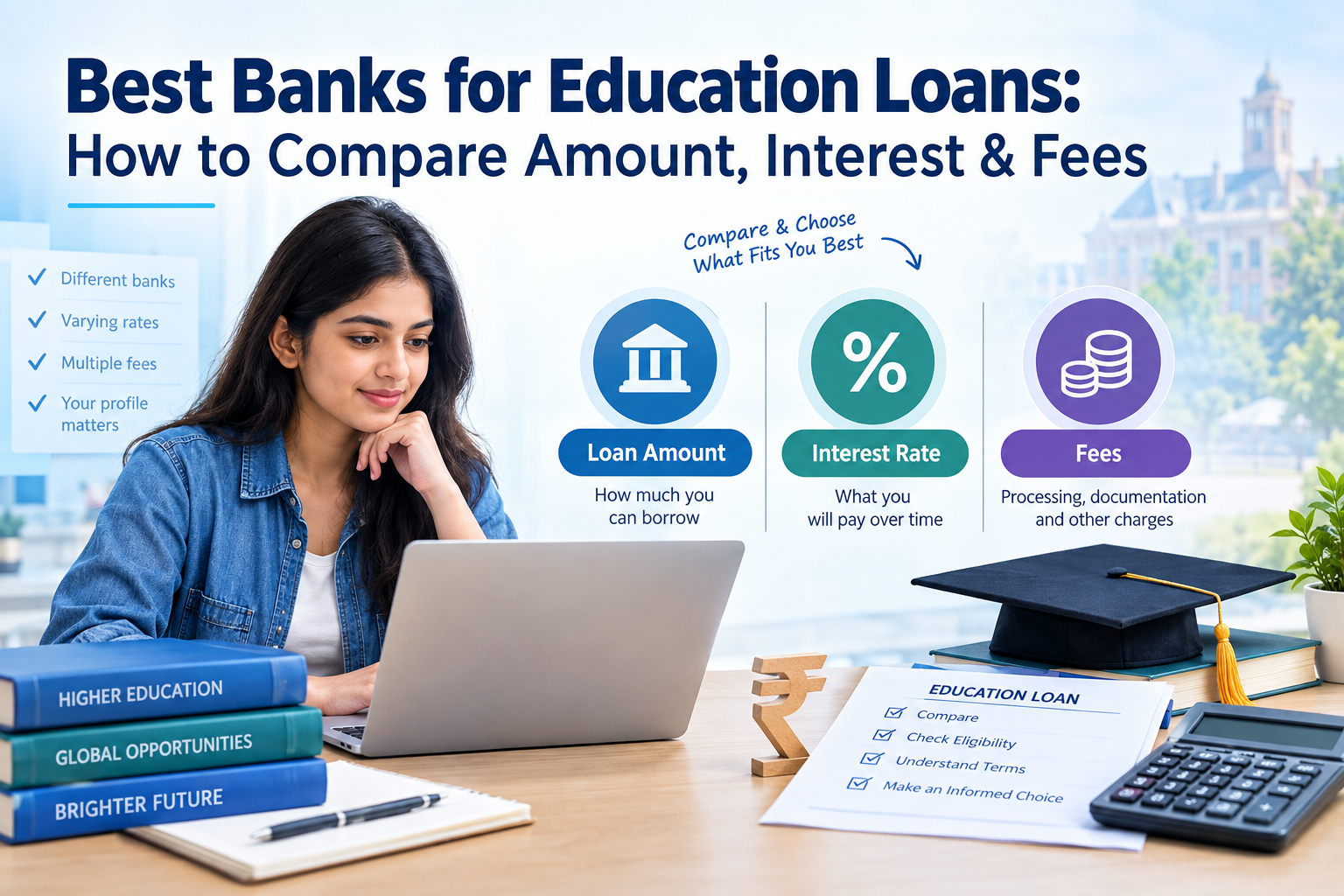
Best Banks for Education Loans: How to Compare Amount, Interest & Fees
By Subraxo Editorial Team. Last updated 23 September 2026.
To find the best bank for your education loan, compare these 8 factors across at least three lenders:
- The interest rate actually offered to you, and the benchmark it is linked to
- The maximum loan amount and how much you can borrow without collateral
- Margin money, the share of costs your family must pay itself
- Processing fees and every other charge, from legal fees to insurance
- Moratorium terms: simple or compound interest, and whether payments are expected
- Repayment tenure and prepayment rules
- Processing time and whether your university is on the lender's approved list
- Concessions for girl students, top universities and paying interest early
There is no single best bank for education loans in India. The right lender depends on your university, loan amount, collateral and co-applicant, and the lender with the lowest advertised rate is often not the cheapest once fees and moratorium interest are counted. This guide profiles the leading lenders and shows you exactly how to compare offers.
The Best Education Loan Lender by Situation
Start here. Your situation narrows the field faster than any ranking.
Your situation | Lenders to shortlist first | Why |
|---|---|---|
You have property or an FD to pledge | Public sector banks such as SBI, Bank of Baroda, PNB, Union Bank, Bank of India | Usually the lowest rates on secured loans and long tenures |
Admission to a top-ranked university, no collateral | Public bank premier-university schemes, private banks, NBFCs | Higher collateral-free limits for listed universities |
Tight deadline for visa or deposit | NBFCs and private banks | Faster sanction, often in days rather than weeks |
Co-applicant income is modest or informal | NBFCs | More flexible assessment of income and profile |
No co-applicant and no collateral | International lenders such as Prodigy Finance and MPOWER Financing | Lend based on university, course and future earnings |
Studying in India at an eligible institution, family income up to Rs 8 lakh | Banks participating in PM-Vidyalaxmi | Collateral-free loans and interest subvention during the moratorium |
Types of Education Loan Lenders Compared
Every lender falls into one of four groups, and each group has a distinct trade-off between cost, speed and flexibility.
Factor | Public sector banks | Private banks | NBFCs | International lenders |
|---|---|---|---|---|
Interest rate level | Usually lowest | Moderate | Higher | Higher, often in foreign currency |
Collateral-free limit | Lower, except premier-university schemes | Moderate to high for strong profiles | Often the highest | No collateral needed |
Processing speed | Slowest, often several weeks | Faster | Fastest, often days | Fast, largely online |
Interest during moratorium | Usually simple interest, payment optional | Varies, often compound | Often compound, partial payment common | Interest-only payments common |
Flexibility on profile | Strict | Moderate | Most flexible | Depends on university list |
Best for | Secured loans, lowest total cost | Balance of speed and cost | Unsecured loans, urgent cases, weaker co-applicant profiles | Students with no co-applicant or collateral |
Best Public Sector Banks for Education Loans
Public sector banks follow the Indian Banks' Association Model Education Loan Scheme closely. They usually offer the lowest rates, simple interest during the moratorium, repayment tenures of up to 15 years and nil or low processing fees. The trade-off is slower processing and stricter documentation.
State Bank of India (SBI)
SBI is the largest education lender in India, with separate schemes for different needs: Global Ed-Vantage for study abroad, the Scholar Loan for premier Indian institutions, and the Student Loan scheme for other courses. It is best known for competitive rates on secured loans and higher collateral-free limits for students admitted to universities on its approved list. Processing can take longer than private lenders, and abroad loans are handled by designated branches.
Bank of Baroda
Bank of Baroda's Baroda Scholar scheme is a popular choice for students heading to the USA, UK and other major destinations. It offers competitive pricing, especially for secured loans and listed universities. Like other public banks, it works best when you start early and have documents ready.
Punjab National Bank (PNB)
PNB Udaan is PNB's dedicated scheme for studying abroad. PNB stands out as one of the few public sector banks offering both floating and fixed rate options, and it classifies certain top global universities as premium, with lower rates for their students. Check how the premium list applies to your university.
Union Bank of India
Union Bank offers education loans for studying in India and abroad, with competitive rates for secured loans and long repayment tenures. It is a solid option for families with collateral who want public bank pricing.
Bank of India
Bank of India's Star Education Loan covers study in India and abroad, including tuition, living costs and travel. Rates are linked to its repo-based lending rate, and it offers the standard long tenure of public bank loans.
Best Private Banks for Education Loans
Private banks sit between public banks and NBFCs. They are generally faster, more digital and more flexible about which universities they fund, with rates higher than public banks for comparable profiles.
ICICI Bank
ICICI Bank is known for a relatively smooth, digital process and offers both secured and unsecured education loans for study abroad, with unsecured amounts depending on the university and co-applicant profile.
Axis Bank
Axis Bank offers education loans for India and abroad, including collateral-free options for eligible students. It is worth comparing for students who need faster processing than public banks but want bank-regulated pricing.
Best NBFCs for Education Loans
Non-banking financial companies focused on education are often the fastest route to a sanction letter, and they tend to offer the highest collateral-free amounts. They assess the student's university, course and future earning potential alongside the co-applicant's income. The trade-off is higher interest rates, and many charge compound interest or expect partial interest payments during the moratorium.
- Credila: formerly HDFC Credila, one of the largest education-focused NBFCs, with a strong focus on study abroad.
- Avanse Financial Services: offers education loans for India and abroad, including unsecured options for a wide range of universities.
- Auxilo Finserve: an education-focused NBFC offering secured and unsecured study abroad loans.
- InCred Finance: offers education loans with collateral-free options and quick processing.
International Lenders for Students Without a Co-Applicant
If no family member can join the loan and there is no collateral, international lenders may be your only route.
- Prodigy Finance: lends to international students at eligible universities without a co-applicant or collateral, based on future earning potential.
- MPOWER Financing: lends to international students at supported universities in the USA and Canada without a co-applicant or collateral.
These loans are usually in US dollars, so your repayment in rupees depends on exchange rates. Rates are typically higher than Indian bank loans, and only students at the lender's supported universities qualify.
Current rates, limits and fees
Lenders update rates, collateral-free limits and fees often, sometimes several times a year when the repo rate moves. For the latest figures for each lender, see our education loan comparison page, which is updated regularly, and always confirm the final terms in your sanction letter.
How to Compare Education Loans: The 8 Factors That Matter
1. Interest rate: compare the offered rate, not the advertised one
The rate on a bank's website is usually a starting rate for the best profiles. Your offered rate depends on your university, course, collateral, co-applicant profile and loan amount. Always compare the rate written in the sanction letter.
Also check what the rate is linked to:
Rate type | What it means | What to watch |
|---|---|---|
External benchmark (repo-linked) rate | Moves with the RBI repo rate | Rates fall and rise with RBI policy, usually quickly |
MCLR-linked rate | Linked to the bank's marginal cost of funds | Changes more slowly and at set reset dates |
Lender's own reference rate | Common with NBFCs | The lender decides changes; ask how often it has moved |
Fixed rate | Stays the same for a defined period or the whole loan | Predictable, but may carry prepayment charges |
The number that matters most is the spread above the benchmark, because the benchmark changes but the spread usually stays fixed for the life of the loan.
2. Loan amount and collateral-free limit
Check both the maximum loan and how much of it you can get without pledging property. For many public banks, loans up to Rs 7.5 lakh need no collateral. Above that, most ask for security, although premier-university schemes, private banks and NBFCs may go much higher without it for strong profiles.
Also check what the loan will cover. A good education loan covers the full cost of study, not just tuition:
- Tuition and university fees for the whole course.
- Accommodation, deposits and living expenses.
- Travel to the destination.
- Health insurance required by the university or visa.
- Laptop, books, equipment and study tours.
- Caution deposits and building funds, where applicable.
3. Margin money
Margin money is the share of the total cost the family pays itself. Under the IBA model scheme, it typically works like this:
Loan amount or destination | Typical margin |
|---|---|
Up to Rs 4 lakh | Nil |
Above Rs 4 lakh, studies in India | 5 percent |
Above Rs 4 lakh, studies abroad | 15 percent |
Margin is collected in parts at each disbursement, not all upfront, and scholarships can often count towards it. NBFCs and some private banks finance up to 100 percent of costs, which can matter a lot if the family has limited savings.
4. Processing fees and hidden charges
Two loans with the same rate can cost different amounts because of fees. Ask every lender for a full list of charges, and compare them side by side.
Charge | What to ask |
|---|---|
Processing fee | Flat amount or a percentage? Plus GST? Refundable if the loan is not taken? |
Legal and valuation fees | Charged separately for secured loans? How much? |
Stamp duty and registration | Payable on the mortgage documents; varies by state |
Insurance | Is a life or property insurance policy mandatory? Is the premium added to the loan? |
Administrative or documentation fees | Any other one-time charges? |
Penal charges | What is charged for late EMIs? |
Prepayment or foreclosure charges | Any charges for early repayment? Floating-rate loans to individuals should have none |
Lenders must show all charges in the Key Facts Statement, including the annual percentage rate, which captures the total cost of borrowing including fees. Ask for it before you accept.
5. Moratorium terms
The moratorium is the course period plus a grace period, usually 6 to 12 months, during which you do not pay EMIs. The key differences between lenders are:
- Simple or compound interest: public banks usually charge simple interest during the moratorium; many private lenders charge compound interest.
- Payment expected or optional: some lenders require full or partial interest payments during the course.
- Concession for paying interest: many banks cut the rate for students who service interest during the moratorium.
These terms can change the total cost more than a small difference in interest rate.
6. Repayment tenure and prepayment
Public banks usually offer up to 15 years of repayment after the moratorium, while NBFCs and international lenders often offer 10 to 12 years. A longer tenure lowers the EMI but raises total interest.
Check prepayment rules too. Under RBI rules, lenders cannot charge prepayment fees on floating-rate loans taken by individuals for non-business purposes, so you can repay faster once you are earning. Fixed-rate loans may carry charges.
7. Processing time and approved university lists
Public banks can take several weeks from application to sanction, especially for secured loans that need legal checks and property valuation. NBFCs and private banks can often sanction in days. If you need a sanction letter for a visa or deposit deadline, speed may matter as much as price.
Many lenders also keep lists of approved or premier universities. Being on a lender's list can unlock higher collateral-free amounts and lower rates, so check where your university stands with each lender.
8. Concessions and special schemes
- Girl students: many public banks offer a rate concession, commonly 0.5 percent.
- Paying interest during the moratorium: some banks cut the rate, often by up to 1 percent.
- Premier institutions: lower rates and higher unsecured limits for listed universities.
- Loan protection insurance: some lenders offer a small rate concession if the loan is insured.
- Government schemes: for studies at eligible Indian institutions, PM-Vidyalaxmi and the Central Sector Interest Subsidy scheme can reduce interest during the moratorium for eligible families. These do not apply to universities abroad.
Worked Example: Why the Headline Rate Is Only Part of the Story
Consider two illustrative offers for a Rs 40 lakh loan for a 2-year master's abroad, with a 6-month grace period and a 10-year repayment tenure. For simplicity, the example assumes the full amount is disbursed at the start and no interest is paid during the moratorium.
Feature | Offer A: public bank, secured | Offer B: NBFC, unsecured |
|---|---|---|
Interest rate | 9.5% | 11.5% |
Interest during moratorium | Simple | Compound |
Fees | About Rs 25,000 in legal and valuation charges | 1% processing fee plus GST, about Rs 47,200 |
Principal when EMIs start | about Rs 49.5 lakh | about Rs 53.3 lakh |
Monthly EMI | about Rs 64,100 | about Rs 74,900 |
Total interest and fees | about Rs 37.1 lakh | about Rs 50.3 lakh |
A 2 percentage point gap in the headline rate turns into a difference of around Rs 13 lakh once compounding and fees are counted. That does not make Offer B wrong. If a family has no collateral or needs a sanction letter in a week, the NBFC may be the only practical choice. But it shows why you should compare total cost, not just the rate, and why refinancing to a cheaper lender later can be worth exploring.
Your Education Loan Comparison Checklist
Ask every lender these questions and put the answers side by side before you decide:
- What is the exact interest rate offered to me, and what benchmark and spread is it based on?
- Is the rate floating or fixed?
- What is the maximum loan amount, and how much is available without collateral?
- What expenses does the loan cover beyond tuition?
- How much margin money must we pay, and when?
- What is the processing fee, and is it refundable?
- What legal, valuation, stamp duty and insurance costs apply?
- Is interest during the moratorium simple or compound, and must we pay it during the course?
- Is there a concession for paying interest early, for girl students or for my university?
- What is the moratorium length and the maximum repayment tenure?
- Are there any prepayment or foreclosure charges?
- How long will sanction and first disbursement take?
- What is the annual percentage rate in the Key Facts Statement?
How to Get a Better Deal on Your Education Loan
- Apply to more than one lender: a sanction letter from one lender gives you real leverage with another. Some families apply to a public bank and an NBFC together, so they have a fast option and a cheaper option.
- Strengthen the co-applicant profile: a co-applicant with a credit score above about 700 and low existing EMIs gets better terms.
- Offer partial security: even an FD covering part of the loan can lower the rate at some lenders.
- Ask about concessions directly: girl student, premier university and interest-servicing concessions are not always applied automatically.
- Negotiate fees: processing fees are sometimes reduced or waived, especially during lender campaigns.
- Plan to refinance: once you have a stable job, moving to a cheaper lender can cut your remaining interest.
Red Flags When Comparing Education Loan Offers
- A lender that will not put the rate, fees and moratorium terms in writing before you pay anything.
- Pressure to pay a large non-refundable fee before sanction.
- Mandatory insurance products with unclear premiums bundled into the loan.
- Vague answers about whether interest compounds during the moratorium.
- An agent promising "guaranteed approval" regardless of your profile.
How Subraxo Helps You Choose the Best Education Loan
Comparing lenders one by one takes weeks, and most families only see the advertised rate. That is where Subraxo helps.
- One application, multiple lenders: as an official partner of 14+ banks, Subraxo helps you compare offers side by side on rate, collateral, fees and moratorium terms.
- Negotiation support: we help you understand where rates and fees can be improved, and use competing offers to get better terms.
- Faster sanctions: we match your profile to lenders likely to approve it quickly, so public bank timelines do not put your visa at risk.
- Beyond sanction: we support you through disbursement and the final transfer to your university.
- Borrowing less: our scholarship search helps you find awards that reduce the loan you need.
- Zero service fee: Students do not pay Subraxo for this support.
FAQs on the Best Banks for Education Loans
Which is the best bank for an education loan in India?
There is no single best bank for everyone. Public sector banks such as SBI, Bank of Baroda and PNB usually offer the lowest rates for secured loans. Private banks and NBFCs are faster and more flexible for unsecured loans. The best choice depends on your university, loan amount, collateral and co-applicant.
Which bank gives the lowest interest rate on education loans?
Public sector banks generally offer the lowest education loan rates, especially for secured loans and students at premier institutions. However, the offered rate depends on your profile, and the lowest rate is not always the lowest total cost once fees and moratorium interest are included. Compare the annual percentage rate in each Key Facts Statement.
Are public banks better than NBFCs for education loans?
Public banks are usually cheaper, with simple interest during the moratorium and longer tenures. NBFCs are faster, more flexible about co-applicant income and offer higher collateral-free amounts, but at higher rates. If you have collateral and time, a public bank is often better. If you need speed or have no collateral, an NBFC may suit you.
Which lender is best for an education loan without collateral?
For students at top-ranked universities, public bank premier-university schemes can be the cheapest collateral-free option. Private banks and NBFCs such as Credila, Avanse and Auxilo offer higher unsecured limits for a wider range of universities. Students with no co-applicant can consider international lenders like Prodigy Finance and MPOWER Financing.
What should I compare besides the interest rate?
Compare the maximum loan and collateral-free limit, margin money, processing and other fees, simple versus compound interest during the moratorium, whether payments are expected during study, repayment tenure, prepayment rules, processing time and concessions. Together, these decide the true cost of the loan more than the headline rate alone.
How much processing fee do banks charge on education loans?
It varies widely. Many public sector banks charge nil or a small fee, sometimes refundable on disbursement. Private banks and NBFCs often charge a percentage of the loan amount plus GST. Secured loans may add legal, valuation and stamp duty costs. Ask each lender for the complete list of charges in writing.
Can I apply for an education loan with more than one bank?
Yes. Applying to two or three lenders lets you compare real offers and negotiate. Each lender will check the co-applicant's credit report, so apply within a short window. Once you choose a lender, inform the others and cancel their applications so you do not take on more than one loan.
Is the interest rate on education loans fixed or floating?
Most Indian bank education loans have floating rates linked to an external benchmark such as the RBI repo rate or to the bank's MCLR, so the rate changes over time. Some lenders offer fixed rates. Floating-rate loans to individuals carry no prepayment charges, while fixed-rate loans may.
How long do banks take to sanction an education loan?
Public sector banks can take several weeks, especially for secured loans that need legal checks and property valuation. Private banks and NBFCs often sanction within days once documents are complete. Start early if you are applying to a public bank, and keep a faster option in mind for visa deadlines.
Do banks give a lower education loan rate to girl students?
Many public sector banks offer a concession, commonly 0.5 percent, to girl students. Some private lenders offer similar benefits. The concession is not always applied automatically, so ask the lender to confirm it in your sanction letter.
What is margin money in an education loan?
Margin money is the portion of the total cost the family pays itself. Under the IBA model scheme, it is typically nil up to Rs 4 lakh, 5 percent for studies in India and 15 percent for studies abroad above that amount. It is usually paid in parts at each disbursement, and scholarships can often count towards it.
Can I switch to another lender after taking an education loan?
Yes. You can transfer or refinance your education loan to another lender offering a lower rate or better terms. It usually makes sense once you have a stable income and good credit score. Compare the rate difference against processing and legal fees, and check the new lender's terms before switching.
Conclusion
The best bank for your education loan is the one whose total cost, speed and requirements fit your situation, not the one with the lowest advertised rate. Shortlist lenders by your profile, compare the eight factors side by side, get offers in writing and use them to negotiate. A few hours of comparison can save you lakhs over the life of the loan.